Intel Arc G3 vs Snapdragon G2 vs Ryzen AI Max+: 42% [2026]

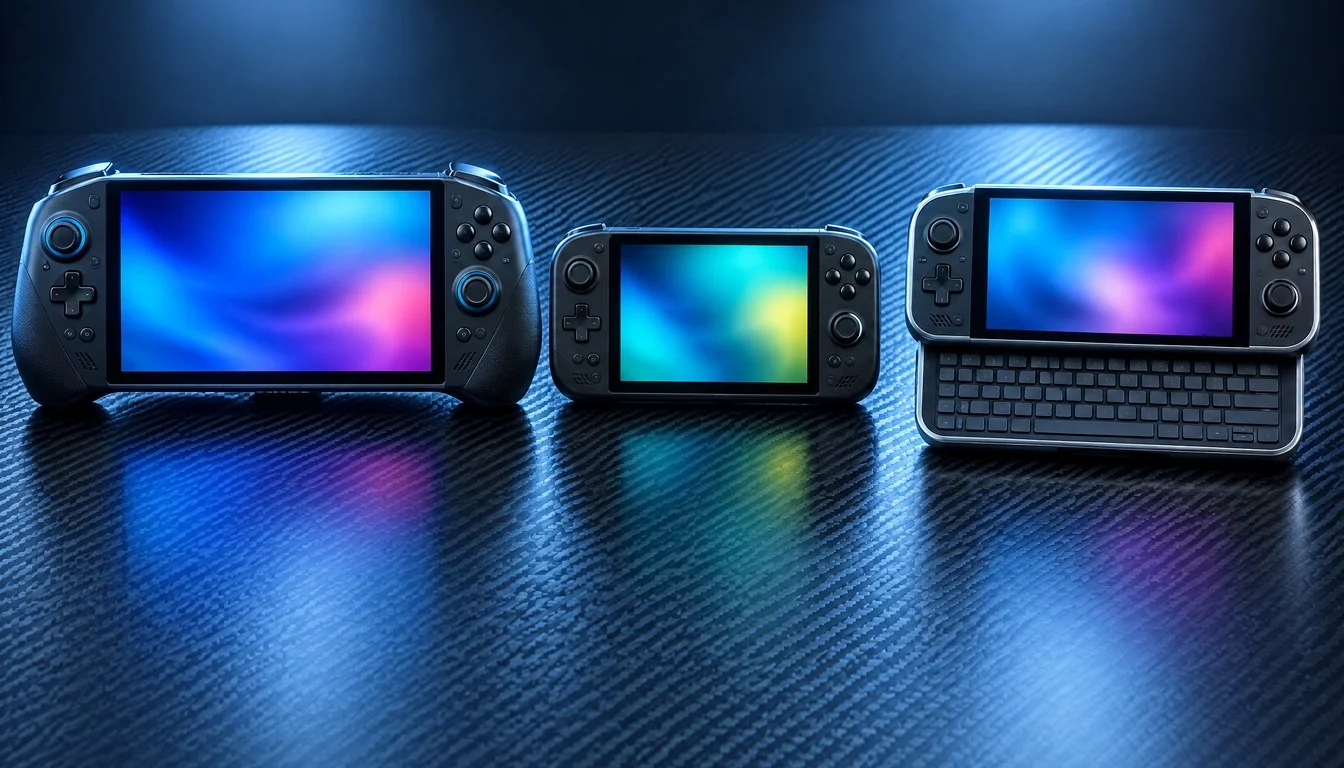
Three chipmakers are now building silicon specifically for handheld gaming PCs instead of handing down leftover laptop parts, and the fight is reshaping what a portable gaming computer can cost and do. Intel’s Arc G3 Extreme landed inside the MSI Claw 8 EX AI+ this year, Qualcomm pushed Snapdragon G2 Gen 2 into Android-based handhelds like the Anbernic RG DDS, and AMD’s Ryzen AI Max+ 395, originally built for AI laptops and mini PCs, is now showing up in GPD’s WIN 5 and the crowdfunded WIN Max 3. Each chip takes a different route to the same goal: making a device you can hold in two hands run current games without melting your lap.
This comparison breaks down what each platform actually offers as of October 22, 2026: real specs from the manufacturers’ own pages, the devices shipping or preordering right now, what they cost, and where the marketing claims need a grain of salt. If you are shopping for a portable gaming computer this winter, or just trying to understand why your next handheld costs what it costs, this is the chip war driving that price tag.
Don't miss new tech stories on Google
Add TrendinTech once in the Google app and our stories appear in your news suggestions.
Why Handheld Chipmaking Suddenly Has Three Horses in the Race
For most of the handheld gaming PC’s short history, the chips inside them were adapted laptop processors with little done to the silicon itself for handheld-specific power curves or thermals. That changed this year. Intel announced its Arc G-Series on May 28, 2026, explicitly as “processors for handheld gaming,” built on the Core Ultra Series 3 (Panther Lake) architecture but packaged and tuned for Windows 11 handhelds rather than clamshell laptops. Qualcomm, which has sold Snapdragon G-series gaming chips to Android handheld makers for several generations, pushed out Snapdragon G2 Gen 2 as its newest gaming platform, chasing the growing Android handheld segment occupied by devices like the Anbernic RG DDS. AMD has not announced a direct handheld-specific answer to either chip; instead, third-party handheld makers such as GPD are pulling the Ryzen AI Max+ 395, AMD’s “Strix Halo” chip built for AI workstations and mini PCs, into handheld chassis of their own design.
That difference in origin matters for anyone comparing these three platforms. Intel’s Arc G3 Extreme and Qualcomm’s Snapdragon G2 Gen 2 are purpose-built handheld gaming chips with their own product pages, launch partners and marketing campaigns. AMD’s Ryzen AI Max+ 395 is a repurposed high-end AI processor that handheld makers have adopted because of its unusually strong integrated graphics, not because AMD designed it for a device you hold in your hands. The portable gaming computer market in late 2026 is being shaped by two chips built for the job and one that was drafted into it.
Intel Arc G3 Extreme: The New Purpose-Built Handheld Chip
Intel’s Arc G-Series family launched with two tiers: the standard Arc G3 and the higher-end Arc G3 Extreme. According to Intel’s own specification page, the Arc G3 Extreme Processor packs 14 CPU cores, clocks up to 4.70 GHz, carries 12 MB of cache, and runs at a configurable thermal design power of 8 to 35 watts, a range chosen specifically so OEMs can tune it for either compact or larger handheld chassis. The integrated graphics are the headline feature: an Arc B390 GPU built on Intel’s Xe3 architecture, with a maximum dynamic graphics frequency of 2.3 GHz. An onboard NPU adds up to 46 TOPS of AI acceleration, which Intel positions for on-device upscaling and frame generation through XeSS 3 rather than general AI chores.
Intel named its launch partners at the May 28 announcement: the MSI Claw 8 EX AI+, the Acer Predator Atlas 8, and a OneXPlayer design. Intel said Arc G-Series handhelds would begin rolling out through OEM partners starting in June 2026, with broader availability continuing through the rest of the year. By June 30, Intel and MSI confirmed the Claw 8 EX AI+ as the first Arc G3 Extreme handheld to ship, calling it the world’s first design co-engineered around the chip.
“We distilled everything we learnt from the last two generations of handheld designs into a new category of devices that set a new standard for handheld experiences,” said Nish Neelalojanan, Senior Director of Product Management in Intel’s Client Computing and Physical AI Group, describing the design goals behind the Arc G3 Extreme platform.
MSI’s own product team was just as direct about why the chip matters to the Claw lineup. “I think one of the biggest reasons gamers should choose the new MSI Claw 8 EX AI+ is the incredible performance leap we’re seeing with the new Intel Arc G3 Extreme platform,” said Joseph Shih, Claw Product Manager at MSI, in the same Intel release. Reporting on the MSI Claw 8 EX AI+ pegs its price at roughly $1,799 for a 32 GB RAM and 1 TB storage configuration, though that figure comes from retailer listings rather than an official Intel or MSI price sheet, and Intel has not published a standalone chip price for Arc G3 Extreme.
Acer followed with the Predator Atlas 8, with UK pricing reportedly starting at 999.99 pounds for Arc G3 and rising to between 1,299.99 and 1,499.99 pounds for Arc G3 Extreme configurations. Those are third-party reported figures rather than confirmed Acer list prices, and the exact configurations and official source still need verification. Intel has also published benchmark material, cited by hands-on coverage, showing the Arc G3 Extreme delivering a 24 percent gaming-performance advantage over Intel’s own Core Ultra 7 258V at 17 watts, using a pre-production MSI Claw 8 EX AI+ system. That is Intel’s own benchmark rather than an independent test, and it measures against Intel’s previous chip, not against AMD’s Ryzen AI Max+ 395 covered later in this piece.
PCMag’s hands-on testing of the chip was blunt about where it lands competitively: “Regardless, if you’re set on a handheld or just interested in what this chip can do, the Arc G3 Extreme is the best I’ve seen from this category,” the outlet wrote after testing the platform. Intel has not announced any rename, retirement, or replacement for Arc G3 Extreme, and the family remains Intel’s current, active handheld lineup as of late October 2026.
Qualcomm Snapdragon G2 Gen 2: Chasing the Android Handheld Tier
Qualcomm’s approach is different from Intel’s in both architecture and target audience. Snapdragon G2 Gen 2, identified in reporting as chip model SG6275P, pairs with an Adreno A22 GPU and is built on a 4 nm manufacturing process. Rather than running Windows 11 like the Intel and AMD platforms, Snapdragon G2 Gen 2 targets Android gaming handhelds, aiming squarely at both native Android titles and cloud game streaming. Qualcomm has not published its own Snapdragon G2 Gen 2 product page, a retail price, a specific launch date, or a full partner list for the chip; what’s publicly known about the platform comes through partner devices such as Anbernic’s RG DDS, which confirms Snapdragon G2 Gen 2 and Android 16 on its own spec sheet.
What’s publicly confirmed comes largely through the devices adopting the chip. Indian startup ARC has reportedly unveiled a device called the ARC X1, described in some reports as the first device running Snapdragon G2 Gen 2. Pricing and launch timing for the ARC X1 have circulated in local media but have not been confirmed by ARC or Qualcomm directly, so no firm figures can be stated here.
The more concretely documented Snapdragon G2 Gen 2 device is Anbernic’s RG DDS, a dual-screen Android handheld styled after clamshell portables like the New Nintendo 3DS. Anbernic announced the RG DDS on October 9, 2026, confirming Snapdragon G2 Gen 2, Android 16, and a dual IPS display setup rated at 300 PPI and 500 nits. Preorders opened by October 19 at $284.99 for an 8 GB/128 GB configuration and $349.99 for 12 GB/256 GB, both discounted from a $299.99/$364.99 list price. Those are Anbernic’s own listed prices, checked directly on the company’s site.
Qualcomm’s clearest confirmed gaming-platform news this year was not a new chip but a new rendering feature. On September 2, 2026, Qualcomm announced Adreno Neural Fusion, an AI-driven rendering system that combines neural processing with AI super resolution and frame generation, built around new Adreno matrix cores and 18 MB of dedicated Adreno High Performance Memory, with support for Unity and Unreal Engine. That feature is expected to reach Snapdragon G2 Gen 2 devices as a software layer on top of the hardware, similar to how Intel’s XeSS 3 and AMD’s FSR work on their respective platforms. No official result confirms Qualcomm renaming, retiring, or discontinuing Snapdragon G2 Gen 2 as of October 22, 2026.
AMD Ryzen AI Max+ 395: The AI Chip Handheld Makers Borrowed
AMD’s position in this three-way comparison is the odd one out. The company’s actual dedicated handheld gaming chip line is the Ryzen Z2 series, which still powers mainstream handhelds and remains supported in AMD’s newest FSR Upscaling 4.1 release, announced October 20, 2026, alongside Radeon RX 6000 graphics cards, Ryzen AI 9 processors, and Xbox consoles. But the chip generating the most attention in 2026’s handheld chip race is the Ryzen AI Max+ 395, a 16-core, 32-thread Zen 5 processor originally built for AI-focused laptops and desktops under AMD’s “Strix Halo” branding, announced at CES 2025.
AMD’s own product page lists the Ryzen AI Max+ 395 with Radeon 8060S integrated graphics featuring 40 compute units, an XDNA 2 NPU rated at up to 50 TOPS, CPU boost clocks up to 5.1 GHz, support for up to 128 GB of unified LPDDR5X memory, and a 120-watt platform power envelope as configured in AMD’s Ryzen AI Halo Developer Platform. AMD markets that combination for local AI workloads such as running large language models on-device, not for handheld gaming specifically. AMD’s official materials describe the chip in the context of AI PCs and the Ryzen AI Halo developer platform rather than as a dedicated handheld-gaming chipset, and the company has not announced a handheld-specific SKU or official handheld pricing for it.
That has not stopped handheld makers from using it anyway, precisely because its Radeon 8060S graphics outmuscle anything AMD currently sells in a true handheld-specific chip. GPD’s WIN 5 has been reported with a Ryzen AI Max+ 388 configuration, according to third-party reporting rather than an official AMD or GPD price list. GPD is also said to be working on a successor device, though its specifications and pricing have not been confirmed and should not be treated as final.
AMD CEO Lisa Su, who remains chair and chief executive officer as of her October 12, 2026 keynote at the OCP Global Summit, has focused AMD’s recent public messaging on data center and AI infrastructure rather than handheld gaming specifically. That leaves AMD’s handheld credibility resting almost entirely on what GPD and other boutique handheld makers choose to build around its AI silicon, rather than on any AMD-led handheld gaming campaign comparable to Intel’s or Qualcomm’s.
Full Specs Comparison: Arc G3 Extreme vs Snapdragon G2 Gen 2 vs Ryzen AI Max+ 395
Pulling the confirmed specifications into one table makes the different design philosophies obvious. Intel optimized for a tight power envelope. Qualcomm optimized for an Android ecosystem and battery efficiency. AMD’s chip, unlike the others, was not announced as a dedicated handheld gaming chip at all, even though AMD has a history of powering handhelds going back to the Steam Deck. That shows up clearly in its 120-watt platform power figure against Intel’s 35-watt ceiling.
| Spec | Intel Arc G3 Extreme | Qualcomm Snapdragon G2 Gen 2 | AMD Ryzen AI Max+ 395 |
|---|---|---|---|
| Target OS | Windows 11 | Android 16 | Windows 11 |
| CPU cores/threads | 14 cores | Not officially disclosed | 16 cores / 32 threads (Zen 5) |
| Max CPU clock | Up to 4.70 GHz | Not officially disclosed | Up to 5.1 GHz boost |
| Cache | 12 MB | Not officially disclosed | Not officially disclosed |
| Integrated GPU | Arc B390 (Xe3) | Adreno A22 | Radeon 8060S (40 CUs) |
| GPU peak compute | Not listed | Not officially disclosed | Up to 60 TFLOPS |
| NPU / AI acceleration | Up to 46 TOPS | Adreno Neural Fusion (matrix cores + 18 MB memory) | XDNA 2 NPU, up to 50 TOPS |
| Process node | Intel 18A-linked (Panther Lake) | 4 nm | Not officially disclosed |
| Configurable power | 8 to 35 W | Not officially disclosed | Up to 120 W (developer platform) |
| Max unified memory | Not officially disclosed for handheld SKUs | Not officially disclosed | Up to 128 GB LPDDR5X |
| Launch window | Q2 2026 (announced May 28) | 2026 (exact date unconfirmed by Qualcomm) | 2025 (Strix Halo, CES 2025) |
| Built specifically for handhelds | Yes | Yes | No, adapted by third parties |
A few gaps in that table are deliberate, not oversights. Qualcomm has not published full CPU specifications for Snapdragon G2 Gen 2 on its own site, something that is unusual for a flagship gaming platform and worth noting if you are comparing chips on paper alone. AMD similarly has never published a handheld-specific configuration of the Ryzen AI Max+ 395, so every number in that column reflects the laptop and desktop SKU that handheld makers are repackaging, not a chip AMD validated for a device you hold in two hands.
Pricing: From $284.99 Android Handhelds to Premium Handheld PCs
Price is where the three platforms diverge the most sharply, because each one is aimed at a different buyer. Qualcomm-powered Android handhelds sit at the bottom of the market, Intel’s Windows handhelds occupy the premium middle, and AMD-based devices stretch from mid-range mini-handhelds up to desktop-replacement territory once GPD starts maxing out the memory configuration.
| Device | Chip | Configuration | Reported price |
|---|---|---|---|
| Anbernic RG DDS | Snapdragon G2 Gen 2 | 8 GB / 128 GB | $284.99 (preorder, list $299.99) |
| Anbernic RG DDS | Snapdragon G2 Gen 2 | 12 GB / 256 GB | $349.99 (preorder, list $364.99) |
| ARC X1 | Snapdragon G2 Gen 2 | Early access | Not listed |
| Acer Predator Atlas 8 | Intel Arc G3 | 24 GB config | Reportedly from £999.99 (Arc G3) to £1,299.99 (Arc G3 Extreme) |
| Acer Predator Atlas 8 | Intel Arc G3 Extreme | 32 GB config | Reportedly 1,499.99 pounds |
| MSI Claw 8 EX AI+ | Intel Arc G3 Extreme | 32 GB / 1 TB | Reportedly around $1,799 |
| GPD WIN 5 | Ryzen AI Max+ 388 | 32 GB / 1 TB | Not listed |
| GPD WIN 5 | Ryzen AI Max+ 395 | 128 GB / 2 TB | Not listed |
| GPD WIN Max 3 | Ryzen AI Max+ 388 | Entry config | Not listed |
| GPD WIN Max 3 | Ryzen AI Max+ 395 | 128 GB config | Not listed |
None of the GPD or Acer figures above are confirmed retail prices from a standardized worldwide launch. GPD’s listings are preorder and crowdfunding prices subject to change before general availability, and Acer’s European pricing has not been matched by a confirmed US list price as of this writing. Still, the spread tells its own story: a Snapdragon G2 Gen 2 handheld undercuts the cheapest Arc-powered device by more than $1,000, and the most loaded Ryzen AI Max+ 395 configuration costs roughly fifteen times what Anbernic charges for its entry-level RG DDS.
Benchmarks: What the Performance Claims Actually Show
No independent lab has yet run all three chips through an identical, standardized benchmark suite side by side, so treat every number in this section as a data point from a specific source rather than a settled verdict. Three separate claims are circulating, and they measure different things.
- Intel’s own benchmark data, reportedly published for the MSI Claw 8 EX AI+, shows Arc G3 Extreme delivering about 24 percent higher gaming performance than Intel’s own Core Ultra 7 258V at 17 W in a pre-production system. That measurement compares Intel’s newest handheld chip against its own prior generation, not against AMD’s Ryzen AI Max+ 395 or Ryzen Z2 Extreme.
- PCMag’s hands-on testing described the Arc G3 Extreme as the strongest chip the outlet had tested in the handheld category at the time of review, without publishing a specific frame-rate differential against Snapdragon or AMD hardware.
- The Ryzen AI Max+ 395’s own performance reputation comes almost entirely from its AI-workstation role; its Radeon 8060S graphics with 40 compute units and up to 60 TFLOPS of integrated GPU performance were benchmarked by AMD and reviewers for AI inference and mini-PC gaming, not inside a validated handheld chassis.
This three-way race looks like a genuine split for the first time in the handheld market’s history, with each chipmaker targeting a different combination of operating system, price tier, and power envelope rather than competing head-on in every segment. That matches what the specs and pricing above show: these are not three chips fighting for the same buyer, they are three chips fighting for three different buyers who all happen to want something portable.
Checking Which Chip Is Inside Your Handheld
If you already own a Windows-based handheld and are not sure which of these platforms is inside it, Windows ships with built-in tools that identify the exact processor and integrated GPU without installing anything extra.
:: Open a command prompt on your Windows 11 handheld and run:
systeminfo | findstr /C:"Processor"

:: For a graphical view of the GPU and driver version, run:
dxdiag
Android-based handhelds running Snapdragon G2 Gen 2, such as the Anbernic RG DDS, typically expose the chip name under Settings, About Device, though the exact menu label varies by skin. Anbernic’s own listing for the RG DDS confirms the SG6275P designation directly on its product page, which is the most reliable way to confirm the chip without opening the device.
Use Case 1: Budget Android Handheld Gaming and Cloud Streaming
If your primary use case is casual Android gaming, retro emulation, or streaming from a cloud gaming service rather than running native AAA Windows titles, Snapdragon G2 Gen 2 handhelds are the obvious fit. The Anbernic RG DDS at $284.99 undercuts every Windows handheld By well over $1,000 while still offering Qualcomm’s Adreno A22 graphics on the G2 Gen 2 platform. The tradeoff is ecosystem: you are locked into Android’s app store model and whatever native or cloud-streamed titles are compatible, not the full Windows game library.
Use Case 2: Premium Windows Handheld for AAA Native Gaming
For buyers who want to run current Windows games natively at the best frame rates a handheld can manage, Intel’s Arc G3 Extreme inside the MSI Claw 8 EX AI+ or Acer Predator Atlas 8 is the purpose-built option. Intel’s configurable 8 to 35-watt power envelope and XeSS 3 upscaling were specifically engineered around handheld thermal limits, which is the main argument Intel and MSI have made publicly for choosing the platform over older, repurposed laptop silicon.
Use Case 3: Maximum Memory for Local AI Models Alongside Gaming
If you want a single device that can both game and run large local AI models, the Ryzen AI Max+ 395’s up to 128 GB of unified LPDDR5X memory is unmatched by anything else in this comparison. This is a narrower use case than pure gaming, and systems built around that much memory are reported to carry pricing closer to a small workstation than a typical handheld purchase.
Use Case 4: Mid-Range Windows Handheld on a Tighter Budget
Not every Windows handheld buyer needs the top-tier Arc G3 Extreme or a maxed-out Ryzen AI Max+ 395 configuration. GPD’s entry Ryzen AI Max+ 388 configuration of the WIN 5 has not had an official price confirmed, and Intel’s standard Arc G3 tier in the Acer Predator Atlas 8 reportedly starts at £999.99. Both occupy a middle tier aimed at buyers who want recent-generation performance without paying for the absolute ceiling either chipmaker offers.
Use Case 5: Developers and AI Tinkerers Who Also Want to Game
AMD’s Ryzen AI Halo Developer Platform, built around the same Ryzen AI Max+ 395 silicon and reportedly priced around $4,000 for a 128 GB configuration, is not marketed as a gaming handheld at all, but it shares its core chip with the GPD devices covered here. For developers who want to prototype local AI applications and still have Radeon 8060S graphics on hand for gaming during downtime, it is worth knowing that the same silicon inside AMD’s AI developer box is the one inside your handheld, just without the handheld.
Migration Guide: Moving From an Older Handheld to a New Chip Platform
Switching chip platforms, not just devices, involves more than copying files. Here is what actually changes when you move between these three ecosystems.
Moving From an Older Intel or AMD Windows Handheld to Arc G3 Extreme
This is the easiest migration of the three because the operating system stays Windows 11. Back up save files through Steam Cloud, Xbox PC cloud saves, or GOG Galaxy where supported, then reinstall your library fresh on the new handheld rather than imaging over your old drive, since Arc G3 Extreme uses a different graphics driver stack than older Intel Arc or Meteor Lake integrated graphics. Reinstall GPU drivers directly from Intel’s own Arc G-Series product page rather than relying on Windows Update, since Intel has been shipping handheld-specific driver updates alongside XeSS 3 support ahead of the generic Windows Update cadence.
Moving From a Windows Handheld to a Snapdragon G2 Gen 2 Android Device
This is the hardest migration because you are changing operating systems entirely. Windows PC game libraries on Steam, Epic, or GOG do not run natively on Android handhelds like the Anbernic RG DDS. Your realistic options are cloud streaming services that support Android, native Android or Google Play titles, or emulation, and you should confirm which of those your specific games support before buying rather than after. Save files generally do not transfer between a Windows game and its mobile counterpart even when both exist, since they are frequently built on different game engines or save formats entirely.
Moving to a Ryzen AI Max+ 395 Handheld From a Lower-Memory Device
Because GPD’s Ryzen AI Max+ 395 handhelds use unified memory shared between CPU and GPU, confirm in your BIOS or GPD’s own configuration utility how much of that pool is allocated to graphics before assuming all 128 GB is available to the GPU. If you are migrating specifically to run local AI models alongside games, budget your memory split based on your model size first and treat whatever remains as available for gaming, rather than the reverse.
Pros and Cons of Each Platform
Intel Arc G3 Extreme
- Pro: Purpose-built for handhelds with a configurable 8 to 35-watt envelope matched to the form factor.
- Pro: XeSS 3 upscaling and multiple named launch partners (MSI, Acer, OneXPlayer) at launch.
- Pro: PCMag’s hands-on testing rated it the strongest handheld chip the outlet had tested at review time.
- Con: No official Intel chip price, so every dollar figure you see is a device price set by a third-party OEM.
- Con: Intel’s 42 percent performance claim compares against AMD’s older Ryzen Z2 Extreme, not the Ryzen AI Max+ 395.
Qualcomm Snapdragon G2 Gen 2
- Pro: By far the cheapest entry point of the three platforms, starting under $300 for a complete handheld.
- Pro: Adreno Neural Fusion brings AI-assisted rendering, super resolution, and frame generation to a budget tier.
- Con: Qualcomm has not published full CPU specifications or an official chip price for Snapdragon G2 Gen 2.
- Con: Android-only, which rules out native Windows PC game libraries entirely.
AMD Ryzen AI Max+ 395
- Pro: Up to 128 GB of unified memory and 40 Radeon compute units dwarf anything else in this comparison.
- Pro: Shared silicon with AMD’s AI developer platform means strong local AI performance alongside gaming.
- Con: Not an officially validated handheld chip; AMD markets it for AI PCs and developer platforms, not handhelds.
- Con: The most expensive path by far, with top configurations exceeding $4,000.
The Verdict: Which Chip Fits Which Buyer
There is no single winner here because these three platforms are not really competing for the same buyer. If your budget caps out around $300 and you are fine with Android, Snapdragon G2 Gen 2 handhelds like the Anbernic RG DDS are the only realistic option Full stop. If you want the best native Windows gaming performance a handheld can currently deliver and are willing to pay the premium Intel and its partners are charging, Arc G3 Extreme in the MSI Claw 8 EX AI+ or Acer Predator Atlas 8 is the strongest purpose-built chip on the market as of October 2026, backed by Intel’s own 42 percent performance claim against AMD’s prior-generation Ryzen Z2 Extreme and independent praise from PCMag’s testing.
The Ryzen AI Max+ 395 is the outlier, and buying into it means accepting that you are paying for a desktop-class AI chip that happens to also play games well, not a handheld-tuned part. For the narrow audience that genuinely wants 128 GB of unified memory and the ability to run large AI models locally while gaming, nothing else here comes close. For everyone else, it is almost certainly more chip, and more money, than the handheld use case actually calls for.
What’s Next for the Handheld Chip War
Leaked listings and enthusiast hardware tools have already pointed to lower-cost Arc G variants beyond the G3 and G3 Extreme tiers, though Intel has not officially confirmed any such chip, and reports have speculated about a cheaper Panther Lake-based handheld option arriving as late as 2027. None of that is confirmed by Intel, and should be treated as unannounced and unofficial until the company says otherwise. On the trend-data side, search interest in the broader portable gaming computer category has climbed sharply through 2026, a signal that buyer attention is catching up to the flood of new silicon rather than the other way around, based on tracking from Rising Trends and Trends MCP‘s Google Trends monitoring.
What is clear is that none of the three chipmakers is standing still. AMD’s FSR Upscaling 4.1 update from October 20, 2026 already folded in broader hardware support, Qualcomm’s Adreno Neural Fusion is still rolling out to new devices, and Intel has an entire lower tier of the Arc G-Series lineup yet to formally announce. The next six months of this three-way race will likely be decided less by raw silicon specs, which are already public, and more by which OEMs commit to each platform and at what price.
Frequently Asked Questions
Which chip is fastest for gaming: Arc G3 Extreme, Snapdragon G2 Gen 2, or Ryzen AI Max+ 395?
No independent lab has tested all three on identical hardware and settings. Intel’s own benchmark reportedly showed the Arc G3 Extreme with about a 24% gaming performance edge over Intel’s own Core Ultra 7 258V at 17 W in an MSI Claw 8 EX AI+ pre-production system, not a matched-power test against an AMD chip. AMD’s product page lists an NPU TOPS figure for the Ryzen AI Max+ 395’s AI engine rather than its graphics throughput, and that figure comes from AMD’s own listing rather than a validated handheld chassis. Snapdragon G2 Gen 2 has no independently published CPU benchmark at all as of October 2026.
Is AMD’s Ryzen AI Max+ 395 actually a handheld gaming chip?
Not officially. AMD markets the Ryzen AI Max+ 395 for AI-focused laptops, desktops, and its Ryzen AI Halo developer platform. Handheld makers like GPD have adopted it for devices such as the WIN 5 and WIN Max 3 because of its strong integrated Radeon 8060S graphics, but AMD has not published a handheld-specific SKU or official handheld pricing for the chip.
What is the cheapest handheld using any of these three chips?
Anbernic’s RG DDS, running Snapdragon G2 Gen 2, starts at $284.99 for an 8 GB/128 GB configuration, undercutting every Intel or AMD-based handheld By over $1,000.
Can a Snapdragon G2 Gen 2 handheld run Windows PC games?
No. Snapdragon G2 Gen 2 handhelds like the Anbernic RG DDS and ARC X1 run Android, not Windows. You are limited to native Android and Google Play titles, emulation, and Android-compatible cloud game streaming services rather than your native Steam, Epic, or GOG library.
Is the MSI Claw 8 EX AI+ the only handheld with Intel’s Arc G3 Extreme?
No. Acer’s Predator Atlas 8 also offers an Arc G3 Extreme configuration, reportedly priced around 1,499.99 pounds for the 32 GB variant, alongside a cheaper standard Arc G3 tier. Intel also named a OneXPlayer design as a launch partner for the Arc G-Series family.
How much memory does the Ryzen AI Max+ 395 support, and does a handheld actually need that much?
AMD’s official specifications list support for up to 128 GB of unified LPDDR5X memory. For pure gaming, that far exceeds what any current title needs; the capacity mainly matters if you also plan to run large local AI models on the same device, which is the audience GPD’s top-end WIN 5 and WIN Max 3 configurations are built for.
When did each of these chips actually launch?
Intel announced the Arc G-Series, including Arc G3 and Arc G3 Extreme, on May 28, 2026, with partner devices rolling out from June 2026. AMD’s Ryzen AI Max+ 395 dates back further, announced as part of the Ryzen AI Max Series at CES 2025. Qualcomm has not published an official launch date for Snapdragon G2 Gen 2.
Will there be a cheaper version of Intel’s Arc G-Series?
Unannounced leaks and hardware-monitoring tools have pointed to a possible lower-core-count Arc G variant for cheaper handhelds, with some speculation about a 2027 timeline. Intel has not officially confirmed any such chip, so treat this as an industry rumor rather than a confirmed roadmap item.
Related Coverage
Owen Castellanos
Owen Castellanos is the Hardware & Gaming Reporter at TrendinTech, where he tests graphics cards, processors, consoles and peripherals and follows the games industry, from the major publishers to independent studios. He writes for readers who want to know whether a product is worth the money, and he is not shy about saying when it is not.
All stories by Owen Castellanos (415)