Best Handheld Console of All Time 2026: 12 Systems Ranked

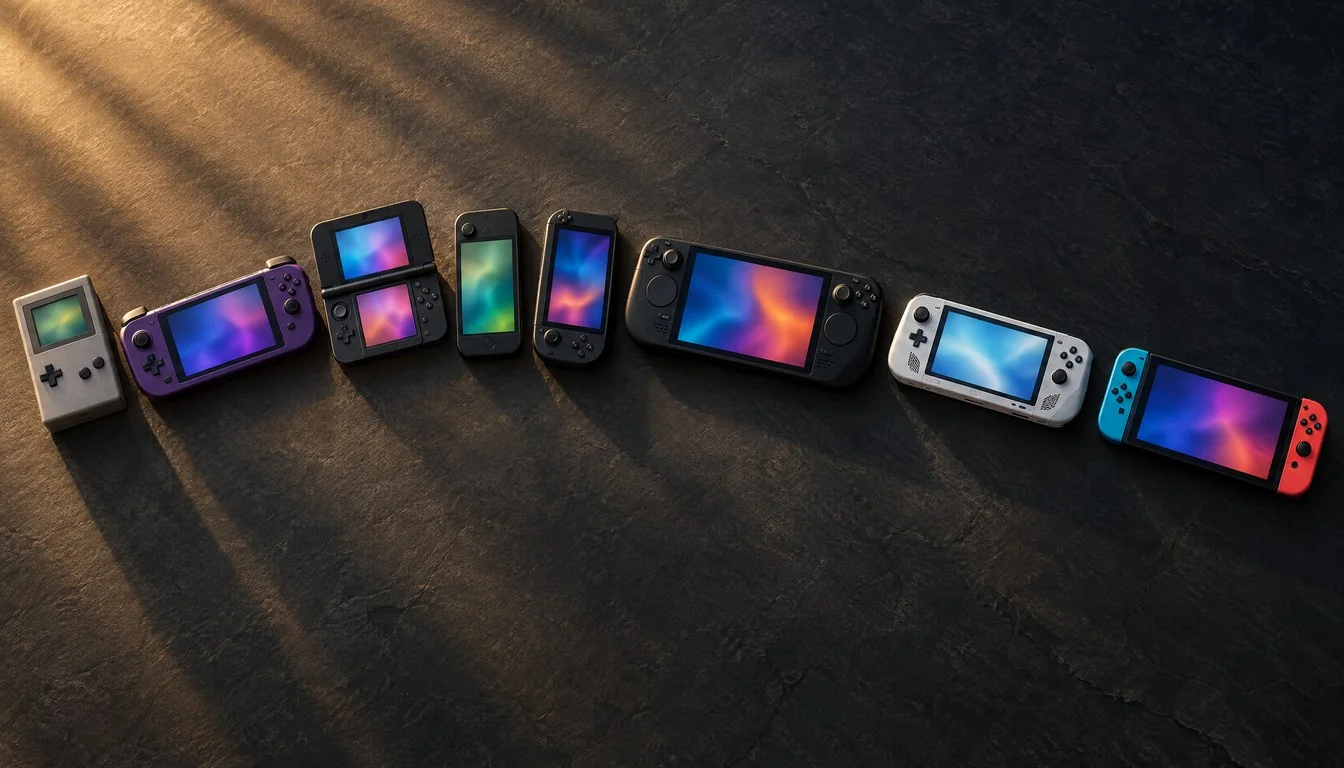
Ranking the best handheld console of all time means putting more than three decades of hardware on the same scale, from a 1989 brick that ran on four AA batteries to a 2026 Windows PC that fits in a jacket pocket. The Nintendo DS still holds the all-time sales crown among dedicated handhelds with roughly 154.02 million units sold, according to Nintendo’s own investor filings, while the Nintendo Switch 2 shipped 19.86 million units by March 31, 2026, and climbed to 23.68 million worldwide by June 30, 2026, per Nintendo’s fiscal year reporting. Those two numbers alone show why “best” cannot just mean “newest” or “most powerful.” A fair comparison has to weigh sales, battery life, game libraries, screen technology, and price against each other, generation by generation.
This guide ranks 12 of the most important handheld consoles ever released, compares their hardware specs side by side, breaks down pricing then and now, and pulls in real sales data and quotes from the people who built these machines. It also includes a migration guide for players moving between console generations, a pros and cons breakdown for the top contenders, and a final verdict backed by the numbers rather than nostalgia alone.
Don't miss new tech stories on Google
Add TrendinTech once in the Google app and our stories appear in your news suggestions.
Why Ranking the Best Handheld Console of All Time Is Harder Than It Looks
A handheld console from 1989 and a handheld PC from 2026 are not solving the same problem. The Game Boy had to survive being dropped, run for ten-plus hours on four AA batteries, and cost little enough that parents would actually buy one. The Steam Deck OLED and ROG Xbox Ally X have to run modern PC games at playable frame rates, which means balancing thermal limits, battery drain, and weight in ways Nintendo’s engineers in the late 1980s never had to think about.
That is why a single raw-spec ranking misleads more than it informs. A 2026 handheld PC will always out-benchmark a 2004 PSP. The more useful question is: which machine did the most with what it had, and which machine changed what a handheld console could be? This comparison scores each system across five weighted categories: unit sales and market impact, game library depth, battery life relative to its era, screen and performance for its era, and price-to-value ratio. A system can score at the top even with modest horsepower if it moved the market, and a powerful modern handheld can lose points if it is priced out of reach of most buyers.
The Best Handheld Consoles of All Time, Ranked
1. Nintendo Game Boy (1989): The Original Template
The Game Boy launched in Japan in April 1989 and in North America that July. It paired a monochrome screen with a cartridge slot and roughly ten to thirty hours of battery life depending on the game, running on four AA batteries. Nintendo never prioritized raw power here: the Game Boy and Game Boy Color family combined sold approximately 118.69 million units worldwide, a figure that still ranks among the best-selling hardware platforms in gaming history. Tetris, bundled with many units, turned the Game Boy into a cultural object rather than just a toy, and its durability became legendary enough that a Game Boy reportedly survived the 1991 Gulf War buried in rubble, still working when dug out. No handheld before or since has matched its combination of simplicity, battery efficiency, and cultural reach relative to its era.
2. Nintendo Game Boy Advance (2001): The Sweet Spot
The GBA launched in 2001 with a 32-bit ARM-based processor and a 2.9-inch, 240×160-pixel screen, and it sold approximately 81.51 million units across its lifetime. The original model’s lack of a backlight was a real weakness, one Nintendo fixed two years later with the Game Boy Advance SP. What made the GBA a generational high point was its library: it could run new 2D titles with console-quality production values while staying backward compatible with the original Game Boy and Game Boy Color catalog. For many retro-gaming communities, the GBA family, including the SP and Micro revisions, is still ranked as one of the best all-around handhelds ever made, balancing portability, game selection, and battery life better than almost anything that followed.
3. Nintendo DS (2004): The Sales Champion
The DS launched in November 2004 at $149.99 and became the best-selling dedicated handheld console ever built, with the full DS family (original, Lite, DSi, DSi XL) reaching approximately 154.02 million units sold worldwide. Dual screens, a touchscreen, and built-in Wi-Fi for local multiplayer were genuinely new ideas for a handheld in 2004, and the DS library ranged from Pokemon and Mario Kart to Brain Age and Nintendogs, which pulled in buyers who had never owned a game console before. No handheld sold since has come close to that number, and none is likely to in the current market given how mobile phones absorbed the casual-gaming audience the DS once owned outright.
4. Sony PSP (2004): The First Real Multimedia Handheld
Sony’s PSP launched in Japan in December 2004 and in North America in March 2005 at roughly $249.99. It packed a 4.3-inch, 480×272 LCD, a MIPS-based processor capable of up to 333MHz, and UMD disc media that could hold full games, movies, and music. The PSP sold approximately 76.4 million units worldwide, making it the first handheld to seriously compete with Nintendo on hardware specs rather than just software charm. Its screen and audio quality were a generational leap for 2004, even if UMD load times and the proprietary disc format frustrated owners. The PSP proved handhelds could be genuine multimedia devices, a lesson that echoes in every PC handheld on the market today.
5. PlayStation Vita (2011): The Best Hardware That Never Got Its Shot
The Vita launched in Japan in December 2011 and in North America in February 2012, priced at $249.99 for Wi-Fi and $299.99 for the 3G model. It featured a 5-inch, 960×544 OLED touchscreen, dual analog sticks, rear touch input, and a quad-core ARM Cortex-A9-based processor. On paper, the Vita was arguably the most advanced handheld of its decade, ahead of anything Nintendo or Sony itself had shipped before it. What it lacked was a strong first-party software pipeline and affordable storage, since Sony’s proprietary memory cards were expensive and third-party publishers drifted toward mobile instead. The Vita ranks high on hardware ambition and low on commercial outcome, a cautionary tale for any handheld that leads with specs over software support.
6. Nintendo 3DS (2011): Backward Compatibility Done Right
The 3DS launched in 2011 with a glasses-free stereoscopic 3D top screen and full backward compatibility with the entire DS library, a decision that protected consumer investment in a way few console makers bother with today. It eventually outsold the Vita by a wide margin and kept Nintendo’s handheld business alive through the transition years before the Switch. The 3D effect itself was a gimmick that most owners turned off within weeks, but the underlying hardware, game library (Pokemon, Fire Emblem, Animal Crossing), and price points kept it commercially relevant for nearly a decade.
7. Nintendo Switch (2017): The Hybrid That Changed the Category
The original Switch launched in March 2017 at $299.99 with a 6.2-inch, 1280×720 LCD screen and Nvidia Tegra-based hardware. Nintendo reported more than 152 million lifetime units sold by its 2025 to 2026 fiscal reporting, placing the original Switch among the best-selling game systems of any kind, handheld or home console. What made it historic was not raw power, which trailed behind the PS4 and Xbox One it launched alongside, but the hybrid concept: one cartridge, one save file, playable docked on a TV or undocked on the go. Nintendo developer Toshiyuki Kawamoto described the thinking behind it directly, explaining in Nintendo’s official Ask the Developer series that “Switch is a dedicated game console that we created so that people can play different types of games in various places and situations,” a design philosophy later extended into the Switch 2 (Nintendo).
8. Valve Steam Deck (2022) and Steam Deck OLED (2023): The PC Handheld Proof of Concept
The Steam Deck launched in February 2022 starting at $399, powered by AMD’s custom “Aerith” APU combining a four-core Zen 2 CPU with an eight-core RDNA 2 GPU, paired with a 7-inch, 1280×800 LCD. Battery life ran roughly two to eight hours depending on the workload. Valve followed up in November 2023 with the Steam Deck OLED, which swapped in a 7.4-inch, 1280×800 HDR OLED panel capable of 90Hz, a larger battery, and better thermals, starting at $549. Valve has not released an official lifetime sales figure, so any specific unit count circulating online should be treated as a third-party estimate rather than a confirmed number. What is confirmed is that the Steam Deck created the entire modern Windows handheld category that ASUS, Lenovo, and MSI now compete in. Valve co-founder Gabe Newell signaled where the category was headed even before the Deck shipped widely, telling Edge magazine that “the second iterations will be more about the capabilities that mobile gives us, above and beyond what you would get in a traditional desktop or laptop gaming environment,” a comment later quoted by The Verge in its original Steam Deck coverage (The Verge).
9. ASUS ROG Ally and ROG Xbox Ally X (2023 to 2026): The Windows Handheld Arms Race
ASUS entered the Windows handheld market with the original ROG Ally in 2023 and has since iterated rapidly, culminating in the ROG Xbox Ally X, a co-branded device built with Microsoft that integrates Xbox app features directly into the handheld’s interface. It competes directly against the Steam Deck OLED on battery capacity, with reporting pointing to an 80Wh battery edge over Valve’s hardware, while running full Windows 11 rather than Valve’s Linux-based SteamOS. It is also one of the devices at the center of the broader Switch 2 versus Windows handheld price-to-performance debate that has defined 2026’s hardware cycle. The tradeoff is the same one every Windows handheld faces: more game compatibility out of the box, including launchers Valve’s OS struggles to run natively, against a less optimized power profile and a higher price.
10. Lenovo Legion Go 2 (2025 to 2026): The Display Specialist
The Legion Go 2 pushes the Windows handheld category toward premium territory with an 8.8-inch, 2K OLED display running at 144Hz, an AMD Ryzen Z2 Extreme processor, and configurations offering up to 32GB of RAM and 1TB of storage. Retail listings have shown pricing as high as $1,999.99 for the top configuration, well above the Steam Deck OLED’s $549 starting price, which puts the Legion Go 2 firmly in enthusiast territory rather than mass-market reach. Its screen size and refresh rate are the best in the Windows handheld class, but that scale works against portability, since the Legion Go 2 is noticeably larger and heavier than the Steam Deck or ROG Ally.
11. Nintendo Switch 2 (2025): The Fastest-Selling Nintendo Hardware
The Switch 2 launched worldwide on June 5, 2025, at $449.99, built around a custom Nvidia processor (codenamed T239) with an eight-core Arm Cortex-A78C CPU and an Ampere-based GPU with 1,536 CUDA cores, plus 12GB of LPDDR5X RAM. The screen jumped to 7.9 inches at full 1920×1080 resolution with HDR and variable refresh rate up to 120Hz in handheld mode, and internal storage grew eightfold to 256GB with support for microSD Express cards up to 2TB. It sold 3.5 million units in its first four days, the fastest hardware launch in Nintendo’s history over that window, then reached 19.86 million units by March 31, 2026, and 23.68 million worldwide by June 30, 2026, according to Nintendo’s own fiscal filings. Nintendo raised the US price to $499.99 effective September 1, 2026, a move tied to broader semiconductor and tariff cost pressure.
12. Retroid Pocket and Anbernic Handhelds (2024 to 2026): The Budget Retro Tier
Below the premium tier sits a fast-growing budget category built around Android-based emulation handhelds from brands like Retroid and Anbernic. These devices, including the dual-screen Retroid Pocket line competing directly against Anbernic’s RG DDS, run older console libraries through emulation at a fraction of the price of a Switch 2 or Steam Deck. They will not run current-generation AAA titles, but for players chasing a specific retro library on modern screens with modern battery life, they fill a price gap neither Nintendo nor Valve directly serves.
Full Specs Comparison: 12 Handheld Consoles Side by Side
| Console | Release Year | Screen | CPU/SoC | Launch Price | Battery Life | Lifetime Units Sold |
|---|---|---|---|---|---|---|
| Game Boy | 1989 | Monochrome, no backlight | 8-bit Sharp LR35902 | $89.99 | 10 to 30 hours (4x AA) | ~118.69M (with Color) |
| Game Boy Advance | 2001 | 2.9″ 240×160, no backlight | 32-bit ARM7TDMI | $99.99 | ~15 hours (2x AA) | ~81.51M |
| Nintendo DS | 2004 | Dual 3″ screens, 256×192 each | ARM9 + ARM7 | $149.99 | ~10 hours | ~154.02M |
| Sony PSP | 2004/2005 | 4.3″ 480×272 LCD | MIPS-based, up to 333MHz | $249.99 | ~4 to 6 hours | ~76.4M |
| PlayStation Vita | 2011/2012 | 5″ 960×544 OLED | Quad-core ARM Cortex-A9 | $249.99 (Wi-Fi) | ~3 to 5 hours | Not officially disclosed |
| Nintendo 3DS | 2011 | 3.53″ 800×240 (3D), 320×240 (bottom) | Dual-core ARM11 | $249.99 | ~3 to 6 hours | 75.94M (Nintendo IR) |
| Nintendo Switch | 2017 | 6.2″ 1280×720 LCD | Nvidia Tegra X1 (custom) | $299.99 | ~4.5 to 9 hours | 152M+ (Nintendo IR) |
| Steam Deck OLED | 2023 | 7.4″ 1280×800 OLED, 90Hz | AMD Zen 2 / RDNA 2 APU | $549 | ~2 to 8 hours | Not officially disclosed |
| ROG Xbox Ally X | 2026 | 7″ 1920×1080 LCD | AMD Ryzen (custom) | Varies by retailer | Up to ~80Wh battery | Not officially disclosed |
| Legion Go 2 | 2025/2026 | 8.8″ 2K OLED, 144Hz | AMD Ryzen Z2 Extreme | Up to $1,999.99 | Varies by config | Not officially disclosed |
| Nintendo Switch 2 | 2025 | 7.9″ 1920×1080 LCD, 120Hz | Nvidia T239 (custom Ampere) | $449.99 (raised to $499.99 Sept 2026) | ~2 to 6.5 hours | 23.68M by June 2026 (Nintendo IR) |
| Retroid Pocket (dual-screen) | 2024/2025 | Dual LCD/OLED (model-dependent) | Android SoC (model-dependent) | Under $300 typically | Varies by model | Not officially disclosed |
A few numbers in that table need context before anyone treats them as a final word. Nintendo’s own fiscal filings show the original Switch declining 64.8% year-on-year to 3.80 million units sold as the Switch 2 took over, a transition visible in the Nintendo investor relations filing for fiscal year 2026. Valve and Sony have never published official lifetime sales for the Steam Deck or Vita respectively, so any number attached to those two systems elsewhere online is a third-party estimate, not a company-confirmed figure, and this comparison treats it that way.
Benchmarks: How These Handhelds Actually Perform
Raw spec sheets only tell part of the story, so it helps to look at how these systems actually perform relative to their era rather than against each other in absolute terms. The Nintendo Switch 2’s custom Nvidia Ampere-based GPU, documented in detail on the SmashWiki technical breakdown of the Switch 2, runs its 12 streaming multiprocessors at 998MHz undocked and 1,101MHz docked, giving developers meaningfully more headroom for 4K docked output and 120fps handheld modes than the original Switch’s Tegra X1 ever offered. That is a real benchmark jump, not marketing language: the original Switch topped out at 720p handheld with no HDR support, while the Switch 2 supports full 1080p HDR at up to 120Hz undocked.
On the PC handheld side, the Steam Deck OLED’s RDNA 2-based GPU and the ROG Xbox Ally X’s newer AMD silicon both target 800p to 1080p gaming at 30 to 60fps in modern AAA titles with upscaling enabled, a benchmark class neither the original Switch nor any Nintendo handheld before the Switch 2 could touch, since none of them were built to run native PC game engines. Independent reviewers at Tom’s Guide, writing in their coverage of current Switch hardware deals, noted that “from the excellent, and noticeably larger, 7.9-inch display to the more powerful internal specs, the Switch 2 is a full leap forward and the best hybrid console you can buy,” a verdict that lines up with the hardware-level jump documented across multiple outlets (Tom’s Guide).
Battery benchmarking tells a different story depending on era. The Game Boy’s 10 to 30 hour runtime on cheap AA batteries remains, proportionally, one of the best battery achievements in handheld history given its 1989 screen technology. By contrast, every PC handheld since the Steam Deck trades battery life directly against performance mode: running a Steam Deck OLED at its highest performance setting can drop runtime toward the two-hour mark, while a lighter indie title or emulator workload can stretch that same hardware closer to eight hours. The Switch 2’s two to 6.5 hour range sits in between, reflecting a hybrid design built to prioritize docked performance over maximum portable runtime.
Pricing Then and Now: What Each Handheld Actually Cost
| Console | Launch Price | Price Adjusted for Inflation (approx.) | Typical Price Today |
|---|---|---|---|
| Game Boy (1989) | $89.99 | ~$225 | Collector’s market only |
| Game Boy Advance (2001) | $99.99 | ~$175 | Collector’s market only |
| Nintendo DS (2004) | $149.99 | ~$245 | Secondhand market only |
| Sony PSP (2005) | $249.99 | ~$395 | Secondhand market only |
| PlayStation Vita (2012) | $249.99 to $299.99 | ~$335 to $400 | Secondhand market only |
| Nintendo Switch (2017) | $299.99 | ~$385 | Still in production, discounted |
| Steam Deck (2022, LCD) | $399 | ~$430 | Still in production |
| Steam Deck OLED (2023) | $549 | ~$575 | Still in production |
| Legion Go 2 (2025/2026) | Up to $1,999.99 (top config) | N/A | Still in production |
| Nintendo Switch 2 (2025) | $449.99 | N/A | $499.99 (raised Sept. 1, 2026) |
The pricing table exposes a trend worth flagging directly: handheld consoles have gotten more expensive in absolute dollar terms with every generation since the Switch launched, and the Switch 2’s price increase to $499.99 effective September 1, 2026, confirms that trend is continuing rather than correcting. Windows handhelds push that further, with the Legion Go 2’s top configuration reaching $1,999.99 at Best Buy, a price point that puts it closer to a gaming laptop than a traditional handheld console.
Real-World Examples: Where Each Handheld Earned Its Reputation
- Game Boy’s durability became a meme before memes existed: a Game Boy unit buried in rubble during the 1991 Gulf War reportedly survived and still powered on, a story Nintendo has referenced repeatedly in its own marketing of handheld durability.
- Nintendo DS turned non-gamers into gamers: Nintendogs and Brain Age sold the DS to buyers, often parents and older adults, who had never purchased a game console before, directly fueling the 154.02 million lifetime unit figure.
- PSP’s UMD format doubled as a portable movie player: Sony sold licensed films on UMD alongside games, a bet that the PSP could be a Walkman successor as much as a game console, years before smartphones made that idea obsolete.
- Steam Deck legitimized PC gaming without a desk: within a month of launch, The Verge’s Sean Hollister wrote that he had found the Steam Deck to be “the most fun I’ve had in years,” a reaction that captured how unexpected it was for a handheld PC to feel that polished at launch (The Verge).
- Switch 2’s GameChat feature kept social play intact across modes: Nintendo engineers specifically designed the system around “the ability to smoothly transition between TV mode and handheld mode while using voice chat as-is in handheld mode,” according to Nintendo’s own developer interview series, preserving a feature players expect from modern multiplayer games (Nintendo).
Pros and Cons of the Top Contenders
Nintendo Switch 2
- Pros: Fastest-selling Nintendo hardware ever at 3.5 million units in four days, 1080p HDR screen, strong exclusive library, broad backward compatibility with most original Switch games.
- Cons: Price increase to $499.99 as of September 2026, battery life as low as two hours under heavy load, GPU still trails dedicated PC handhelds in raw horsepower.
Steam Deck OLED
- Pros: Access to the entire Steam PC library, HDR OLED screen at 90Hz, open software ecosystem, lower starting price than most Windows rivals at $549.
- Cons: SteamOS compatibility gaps with some anti-cheat-protected games, battery life drops sharply in demanding titles, heavier than Nintendo’s handhelds.
Nintendo DS
- Pros: Best-selling dedicated handheld ever at roughly 154.02 million units, dual-screen design that genuinely changed game design, broad and affordable game library.
- Cons: No modern connectivity, resolution and screen quality look dated by any current standard, no backward compatibility with newer digital storefronts.
ROG Xbox Ally X / Legion Go 2
- Pros: Full Windows compatibility, largest and sharpest screens in the handheld category (Legion Go 2 at 8.8 inches, 144Hz 2K OLED), strongest raw performance ceiling of any device in this comparison.
- Cons: Highest prices in the category (up to $1,999.99 for Legion Go 2’s top configuration), heaviest and bulkiest devices, shortest battery life under performance load.
5 Use-Case Recommendations: Which Handheld Fits You
- Casual and family gaming on a budget: A used Nintendo DS or 3DS still delivers one of the deepest, most affordable game libraries in handheld history, and both remain widely available on the secondhand market at a fraction of current-gen prices.
- Current Nintendo exclusives and couch-to-commute hybrid play: The Nintendo Switch 2 is the only device Built specifically around moving between docked TV play and handheld play without losing save progress or performance consistency.
- PC gaming without a desk, broadest software library: The Steam Deck OLED remains the best-value entry into full PC gaming in a handheld form factor, with direct access to a Steam library most players already own.
- Maximum screen quality and performance, budget is not a constraint: The Legion Go 2’s 144Hz 2K OLED display and AMD Ryzen Z2 Extreme processor make it the strongest pure-performance choice, if the up-to-$1,999.99 price tag is acceptable, as detailed in our full 2026 gaming handheld price comparison.
- Retro game collecting and emulation on a modern screen: Budget Android handhelds from Retroid and Anbernic, priced well under $300, target players chasing specific legacy libraries rather than new releases.
Migration Guide: Moving Between Handheld Generations
Players upgrading from an older handheld to a newer one face different migration paths depending on the jump they are making, and skipping the planning step tends to cost either money or saved progress.
- Step 1: Audit your current game library before buying anything. Check which titles you actually still play. A Nintendo Switch owner moving to Switch 2 keeps most physical and digital compatibility, but a DS or 3DS owner moving to Switch 2 loses nearly all of it, since neither platform is backward compatible with Nintendo’s older handheld libraries.
- Step 2: Confirm save data transfer tools before trading in old hardware. Nintendo’s Switch-to-Switch 2 transfer tools move most save data and some purchased software licenses, but the process requires both systems to be online and linked to the same Nintendo Account, so do this before reselling the older unit.
- Step 3: Decide whether you are buying a console ecosystem or a PC. Moving to a Steam Deck, ROG Ally, or Legion Go means inheriting your existing Steam, Epic, or Battle.net library rather than starting over, which can make a PC handheld cheaper in practice even at a higher sticker price.
- Step 4: Check battery and charging standards. Windows handhelds generally use USB-C PD charging compatible with laptop chargers, while Nintendo’s Switch 2 uses its own charging profile; carrying the wrong charger on a trip is a common and avoidable mistake.
- Step 5: Budget for accessories separately. Carrying cases, extra storage (microSD Express for Switch 2, NVMe upgrades for PC handhelds), and screen protectors routinely add $50 to $150 on top of the console price, and that cost is rarely included in launch-day budgeting.
- Step 6: Set expectations for battery life realistically. If the previous device was a DS or 3DS with multi-day standby, every modern handheld on this list, including the Switch 2 and every PC handheld, will feel like a downgrade in raw battery endurance even though it is a major upgrade in performance.
Game Library Depth: The Factor Spec Sheets Miss
None of the hardware numbers above matter if a handheld does not have games worth playing on it, and this is where the ranking shifts most from a pure-spec approach. The Game Boy Advance and Nintendo DS both benefit from being the platforms where entire genres matured: tactical RPGs, portable Pokemon mainline entries, and 2D platformers reached creative peaks on hardware that forced developers to work within tight memory and processing limits. The PSP carved out a reputation in Japan specifically for visual novels and portable JRPGs that never reached the same depth on Nintendo’s hardware of the same era.
Modern PC handhelds flip the equation entirely: instead of a curated, platform-specific library, the Steam Deck and its Windows rivals inherit whatever library the owner already built on PC, which can span fifteen or twenty years of purchases across multiple storefronts. That is a fundamentally different kind of depth, one measured in personal collection size rather than platform-exclusive output. The Switch 2 sits in between, combining Nintendo’s first-party strength with a growing third-party catalog that increasingly includes ports of PC and PS5 titles previously considered too demanding for Nintendo hardware.
Build Quality and Durability Across Eras
Durability is the category where older handhelds tend to win outright. The Game Boy’s plastic shell and simple internals were built to survive drops, spills, and years of use by children, and secondhand units from the late 1980s and early 1990s still power on today. The Game Boy Advance and Nintendo DS continued that philosophy, favoring thick plastic casings over premium materials.
Modern handhelds trade some of that resilience for thinner, lighter designs and premium displays that are more fragile by nature. OLED screens on the Steam Deck OLED and Legion Go 2 are more susceptible to cracking than the thick LCD panels of older Nintendo hardware, and Joy-Con drift complaints that followed the original Switch have carried over, in milder form, to Switch 2 reporting. Buyers prioritizing long-term durability over screen quality should weigh this trade-off directly rather than assume newer automatically means tougher.
What Industry Voices Say About the Handheld Category
The people who built these systems have been fairly direct about what they were trying to solve. Valve’s Gabe Newell framed the Steam Deck’s long-term direction around mobility advantages that a desktop or laptop simply cannot offer, telling Edge magazine that future iterations would lean further into “the capabilities that mobile gives us, above and beyond what you would get in a traditional desktop or laptop gaming environment,” a comment The Verge preserved in its original Steam Deck review (The Verge).
Nintendo’s own developers have been equally specific about the Switch family’s design intent. Toshiyuki Kawamoto explained that the Switch was built as “a dedicated gaming console that packs in the best parts from Nintendo’s previous consoles,” a description that applies just as well to the Switch 2’s expanded feature set as it did to the original 2017 hardware (Nintendo). Taken together, these statements from both companies point to the same conclusion this comparison keeps circling back to: the best handheld consoles of all time were not necessarily the most powerful ones, they were the ones that best matched their hardware to how people actually wanted to play.
The Verdict: Scoring Every Handheld by the Numbers
| Console | Sales Impact | Game Library | Battery (era-adjusted) | Price-to-Value | Overall Rank |
|---|---|---|---|---|---|
| Nintendo DS | 5/5 | 5/5 | 4/5 | 5/5 | 1 |
| Game Boy Advance | 4/5 | 5/5 | 5/5 | 5/5 | 2 |
| Nintendo Switch | 5/5 | 5/5 | 3/5 | 4/5 | 3 |
| Game Boy | 5/5 | 3/5 | 5/5 | 5/5 | 4 |
| Nintendo Switch 2 | 4/5 (early, growing fast) | 4/5 (growing) | 2/5 | 3/5 | 5 |
| Sony PSP | 4/5 | 4/5 | 3/5 | 3/5 | 6 |
| Steam Deck OLED | 3/5 (undisclosed) | 5/5 (full PC library) | 3/5 | 4/5 | 7 |
| Nintendo 3DS | 4/5 | 4/5 | 3/5 | 4/5 | 8 |
| PlayStation Vita | 2/5 (undisclosed, weak) | 3/5 | 2/5 | 2/5 | 9 |
| ROG Xbox Ally X | 2/5 (undisclosed, new) | 5/5 (full PC library) | 2/5 | 2/5 | 10 |
| Legion Go 2 | 2/5 (undisclosed, new) | 5/5 (full PC library) | 2/5 | 1/5 | 11 |
| Retroid Pocket / Anbernic | 2/5 (niche) | 3/5 (emulation-dependent) | 3/5 | 4/5 | 12 |
On this scoring, the Nintendo DS takes the top spot as the best handheld console of all time, driven by the combination of roughly 154.02 million lifetime units sold, one of the deepest game libraries in handheld history, and a price point that stayed accessible across its entire production run. The Game Boy Advance ranks a close second on the strength of its battery efficiency and library depth relative to its 2001 hardware constraints, and the original Nintendo Switch takes third for redefining what a hybrid handheld-console combination could be at scale.
The Nintendo Switch 2 and the current wave of Windows PC handhelds land in the middle of the pack for now, not because their hardware is weak but because they are still early in their commercial lifecycle, their pricing has already started climbing (the Switch 2’s jump to $499.99 in September 2026 being the clearest example), and their full historical impact will not be measurable for several more years. Revisit this ranking again once the Switch 2 approaches the end of its production run and the Windows handheld category settles on pricing that more buyers can actually afford.
Frequently Asked Questions
What is the best-selling handheld console of all time?
The Nintendo DS family holds the title with approximately 154.02 million units sold worldwide across the original DS, DS Lite, DSi, and DSi XL models, according to Nintendo’s investor relations reporting. No other dedicated handheld console has matched that figure.
Is the Nintendo Switch 2 the best handheld console right now?
It is the best current Nintendo hardware and the fastest-selling system in company history, reaching 3.5 million units in its first four days and 23.68 million worldwide by June 30, 2026. Whether it is the single best handheld of all time depends on whether sales momentum and game library growth continue at this pace through its full lifecycle.
Is the Steam Deck better than the Nintendo Switch 2?
They solve different problems. The Steam Deck OLED gives access to an existing PC game library and an open software ecosystem starting at $549, while the Switch 2 offers tighter hardware-software integration, Nintendo’s first-party exclusives, and a simpler setup process at $499.99. Buyers already invested in a Steam library tend to prefer the Deck; buyers who want Nintendo’s exclusive franchises need the Switch 2.
How much battery life does the Nintendo Switch 2 actually get?
Nintendo estimates approximately two to 6.5 hours depending on the game and settings, a range that reflects how demanding the title running on it is rather than a fixed number.
Why did the PlayStation Vita fail despite strong hardware?
The Vita’s 5-inch OLED screen and quad-core processor were ahead of its 2011 to 2012 competition, but Sony never built a deep enough first-party software pipeline to match it, and its proprietary, expensive memory cards discouraged adoption at a time when third-party publishers were already shifting investment toward mobile gaming.
What is the most powerful handheld console available in 2026?
Among the devices The Lenovo Legion Go 2 and ASUS ROG Xbox Ally X offer the highest raw performance ceilings, running full Windows 11 and modern AMD silicon capable of handling current PC game libraries, well beyond what the Switch 2’s mobile-class Nvidia hardware targets.
Should I buy a retro handheld or a modern one in 2026?
That depends entirely on what you want to play. A used Nintendo DS, 3DS, or Game Boy Advance remains the cheapest way into deep, proven game libraries, while a Switch 2, Steam Deck OLED, or Windows handheld is necessary for current-generation titles and ongoing software support.
Why did the Nintendo Switch 2 price increase in September 2026?
Nintendo raised the US price from $449.99 to $499.99 effective September 1, 2026. The increase was tied to broader cost pressures affecting hardware manufacturers rather than a change in the console’s specifications.
Related Coverage
Owen Castellanos
Owen Castellanos is the Hardware & Gaming Reporter at TrendinTech, where he tests graphics cards, processors, consoles and peripherals and follows the games industry, from the major publishers to independent studios. He writes for readers who want to know whether a product is worth the money, and he is not shy about saying when it is not.
All stories by Owen Castellanos (387)