Google on the Edge of Quantum Breakthrough – ” Quantum Supremacy “
Before it began testing it’s 20 qubit chip, Google’s nine qubit chip from 2015, was still their most powerful, and made their year-end quantum computing go

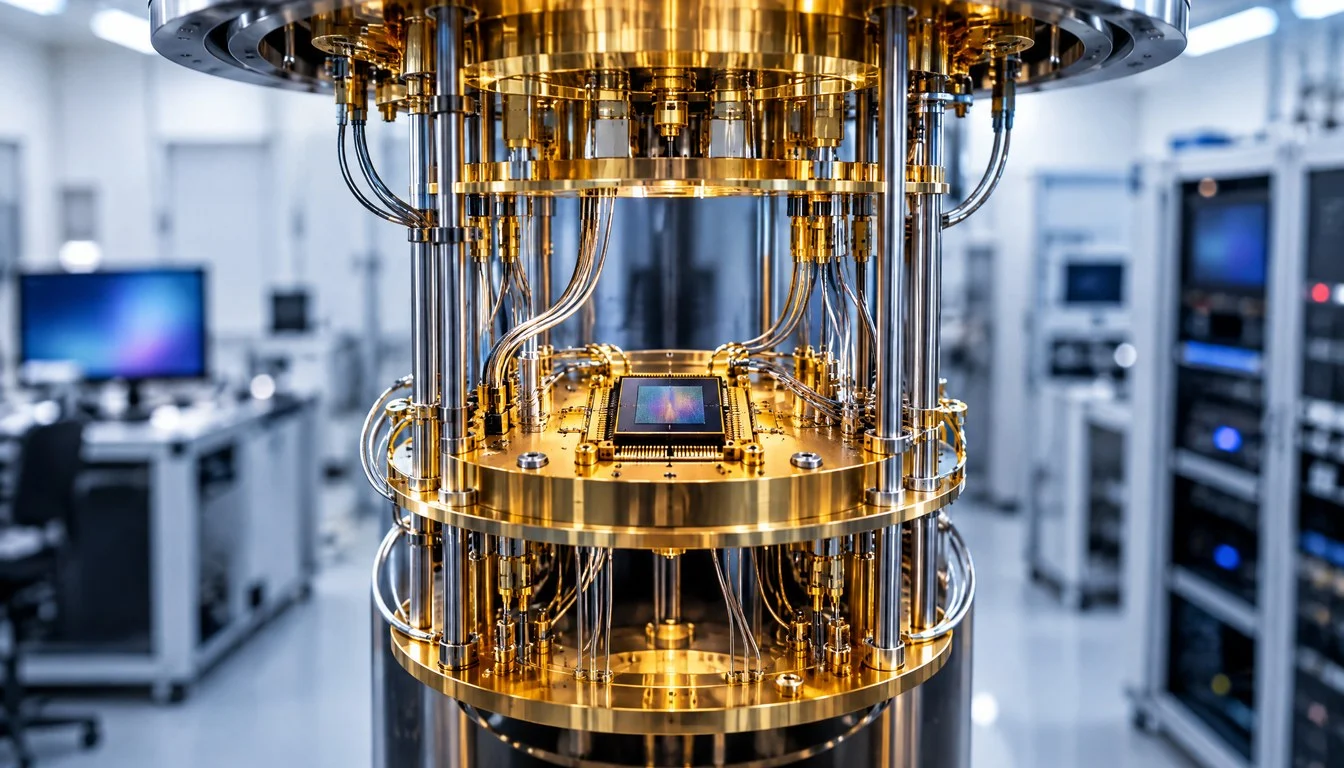
Before it began testing it’s 20 qubit chip, Google’s nine qubit chip from 2015, was still their most powerful, and made their year-end quantum computing goal look far off. Now, however, Google appears to be well placed to have a 49 qubit chip before the end of 2017.
Qubits are the bits of the quantum computing world. Where traditionally a bit can either be a 1 or a 0, either off or on, qubits can do more. Not only can they be in the 1 or 0 position, but they can also be in a superposition where they are both 1 and 0, due to their quantum properties.
Because of this, qubits have a huge potential in terms of computing power and speed. With quantum computers, no longer will a solution be found by testing a single option at a time; several possibilities can be computed at once.
Ultimately, Google is working towards a goal that they call quantum supremacy, where a 49 qubit quantum system can solve problems beyond the capabilities of a traditional computer. To achieve this, they need their 49 qubit chip to operate at a “two-qubit fidelity” of 99.7 percent minimum. Currently, the 20 qubit chip in testing has a two-qubit fidelity of 99.5 percent. A good sign for achieving quantum supremacy by the end of 2017.
In the meantime, Google isn’t the only company working to advance quantum computing. IBM is currently offering 16 qubit system for public beta testing.
And it’s not just a set number of qubits that Google needs nor an accurate chip, but to build practical quantum machines, they will also need to face other challenges like scaling and error correction. But, if they succeed, quantum supremacy will be not only a significant achievement for Google but also a huge advancement in the world of quantum computing.
More News to read
- What Do We Know About The New Planet in Our Solar System?
- This Startup Wants to Translate Your Own Voice into Another Language that You Can’t Speak
- This Startup Might Become the Tesla of the Electric Motorcycles
- Walmart is Playing Dirty, Warns Tech Partners Against Amazon
- The Change of The Power Grid, Thanks to Elon
Comments
Don't miss new tech stories on Google
Add TrendinTech once in the Google app and our stories appear in your news suggestions.
Daniel Okafor
Daniel Okafor is the Senior AI Reporter at TrendinTech, where he covers large language models, machine learning research and the practical use of artificial intelligence across business and government. He has a particular interest in evaluation: how models are benchmarked, where those benchmarks fail and what that means for the companies betting on them.
All stories by Daniel Okafor (352)