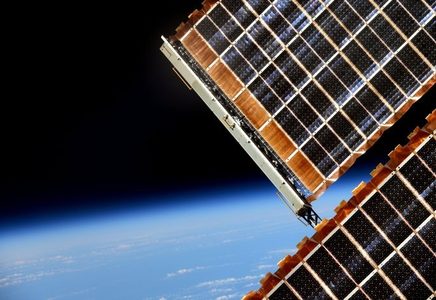
Space-based solar power is a simple idea with a hard engineering problem at its center. A satellite in orbit can collect sunlight almost continuously, without clouds, night or seasons getting in the way. The difficult part is getting that energy down to the ground. There is no cable long enough, so the whole concept depends on wireless power transmission, a technology that is often overlooked in discussions about orbital solar farms.
Two ways to beam power
Researchers have mainly studied two methods. The first converts electricity into microwaves, which are transmitted by a large antenna in orbit to a receiving antenna on the ground, called a rectenna. The rectenna converts the microwaves back into electricity. Microwaves pass through clouds and rain relatively well, which makes them attractive for a system that must deliver power reliably.
The second method uses lasers. A laser beam can be much narrower than a microwave beam, so the receiving station can be smaller. The trade-off is that lasers are more affected by clouds and atmospheric conditions, and converting electricity to laser light and back again involves efficiency losses at each step.
Why the receiving station is so large
A microwave beam spreads as it travels. By the time it reaches the ground from geostationary orbit, it covers a wide area, so rectennas for large systems are expected to be very big. The power density across that area is intended to be low, which is important for safety, but it means that land use is one of the practical considerations for any future project.
Efficiency and losses
Every step in the chain loses some energy: collecting sunlight, converting it to electricity, converting that to microwaves or laser light, transmitting it through space and air, and converting it back to electricity on the ground. Improving each of those steps is an active area of research, because small gains at each stage add up across the whole system.
Safety and control
Any system that beams energy needs to be precisely controlled. Designs typically include a pilot signal from the ground station so that the satellite only transmits when it is correctly aligned, and shuts off if that signal is lost. Keeping the beam's intensity low and restricting access to the receiving area are also part of most proposals.
Experiments so far
Wireless power transmission has been demonstrated over short distances on the ground many times, and national space agencies, including Japan's JAXA, have made it part of long-term research roadmaps for space-based solar power. Small-scale tests are an important step, but scaling up to the size needed for meaningful power delivery is a very different challenge.
Orbits and timing
Most proposals place solar power satellites in geostationary orbit, where they stay above the same point on Earth and can send power to a fixed ground station. The drawback is distance: geostationary orbit is roughly 36,000 kilometers up, which makes the beam spread more and the transmitting antenna larger. Lower orbits reduce the distance but mean each satellite passes over a ground station only briefly, so a constellation and a network of receivers would be needed for continuous delivery.
Weather and the atmosphere
The frequency chosen for power beaming is a careful compromise. Some microwave frequencies pass through the atmosphere with very little loss even in rain, while higher frequencies allow smaller antennas but are absorbed more by water vapor. Engineers also have to coordinate with existing radio users to avoid interference.
The bigger picture
Launch costs, in-orbit assembly and long-term maintenance are all obstacles for space-based solar power. Wireless transmission is the part that turns an orbital power plant into electricity people can use, and it could have other applications along the way, from powering remote sensors and drones to delivering energy to disaster zones. Whether or not orbital solar farms become reality, progress in power beaming is likely to find uses on Earth.